
$4,600: Gold rallies to three-month high, eyes third weekly gain
- Gold heads for a third straight weekly gain, reaching its highest level since mid-May.
- A softer US Dollar and reduced expectations of an imminent Fed rate hike support the precious metal.
- XAU/USD rises above major daily moving averages, with $4,600 acting as the immediate resistance.
Gold (XAU/USD) is heading for a third consecutive weekly gain on Friday, extending an impressive rally that has lifted the precious metal by around 13% so far this month. At the time of writing, XAU/USD trades near $4,590 after briefly climbing above $4,600, its highest level since May 15.
The rally is driven by a combination of factors that have heightened macroeconomic uncertainty and encouraged traders to seek exposure to Gold. The biggest trigger this week was the US Treasury’s surprise decision to double its liquidity-support buybacks for longer-dated government securities to at least $4 billion per operation.
Long-term US Treasury yields initially fell sharply after the announcement but have since recovered most of their losses. However, the rebound has done little to stop Gold’s advance. Concerns about rising US government debt, large budget deficits and persistent inflation are eroding investor confidence in US assets, with the US Dollar (USD) paying the price.
The US Dollar Index (DXY), which tracks the Greenback's value against a basket of six major currencies, is trading around 98.65, near three-month lows.
Uncertainty surrounding the Federal Reserve (Fed) is also adding to the nervous mood. Under Chairman Kevin Warsh, the central bank has placed less emphasis on forward guidance, leaving markets with fewer clear signals about the direction of interest rates. However, recent US employment and inflation data have reduced expectations of a rate hike at the upcoming meeting, providing the spark for Gold’s rally earlier this month.
Meanwhile, continued central-bank purchases, particularly from China, and stronger inflows into Gold exchange-traded funds (ETFs) keep underlying demand firm.
Still, Gold faces some hurdles. Treasury yields remain elevated, increasing the opportunity cost of holding the non-yielding metal. Energy-driven inflation is another concern, as higher Oil prices linked to the US-Iran stalemate could keep inflation above the Fed’s 2% target for longer and maintain pressure on the central bank to raise interest rates.
Technical Analysis: Bulls stay dominant as RSI nears overbought levels
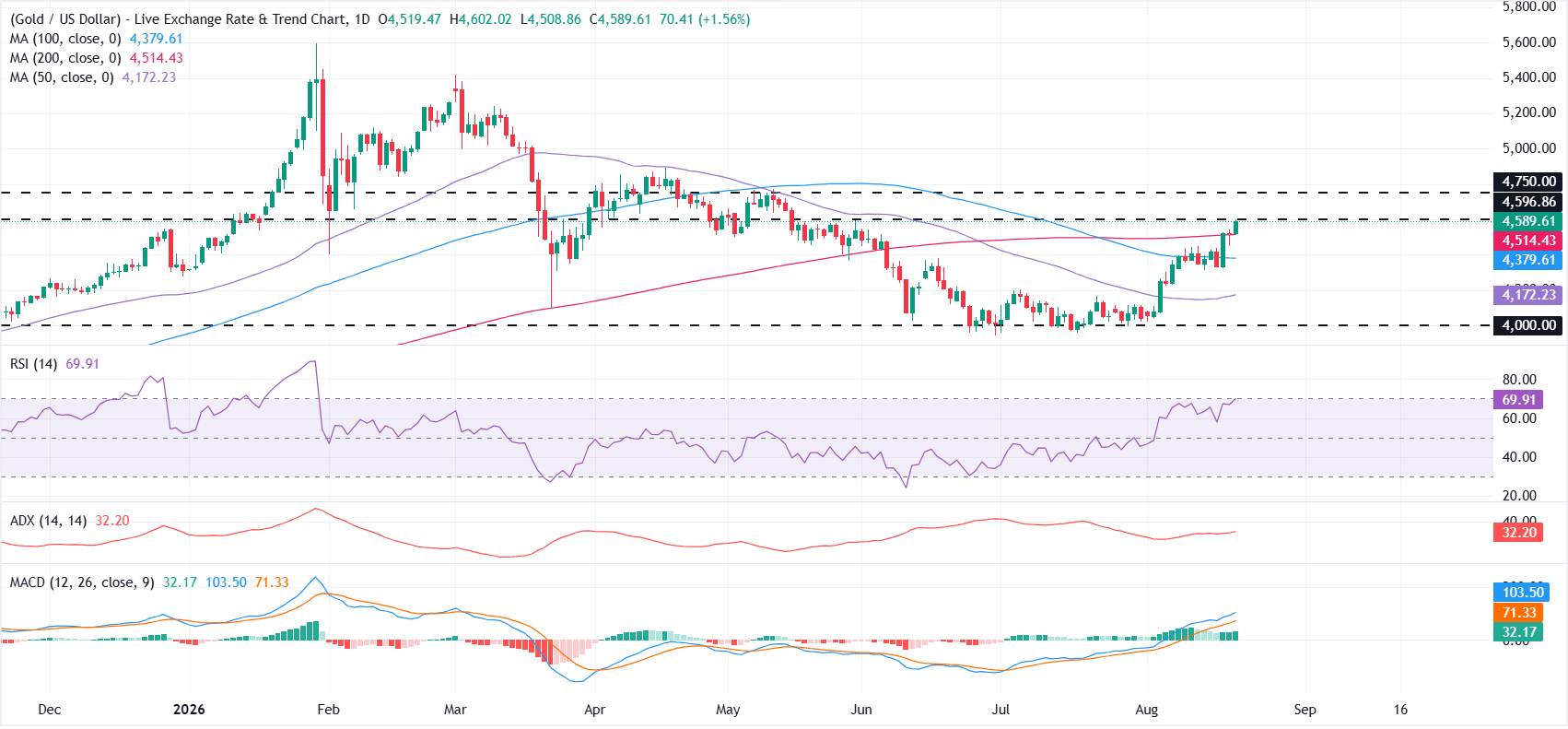
XAU/USD holds a clear bullish bias as it extends above the 50-day, 100-day and 200-day Simple Moving Averages (SMAs), which collectively underpin the recent uptrend. The Relative Strength Index (RSI) on the daily chart is near 70 and flags overbought conditions, while the Average Directional Index (ADX) is around 32, suggesting a moderate trend, and the Moving Average Convergence Divergence (MACD) indicator remains constructive, hinting that upside momentum is strong but getting stretched.
On the topside, immediate resistance emerges at the nearby horizontal level around $4,600, ahead of a higher barrier at $4,750. On the downside, initial support is seen at the 200-day SMA at $4,514, followed by the 100-day SMA at $4,379 and the 50-day SMA at $4,172, before a more distant structural floor at $4,000.
While the trend favors further gains, the overbought RSI warns that any failure to clear $4,600 could trigger a corrective pullback toward these underlying demand zones.
(The technical analysis of this story was written with the help of an AI tool. Know more.)
Gold FAQs
Gold has played a key role in human’s history as it has been widely used as a store of value and medium of exchange. Currently, apart from its shine and usage for jewelry, the precious metal is widely seen as a safe-haven asset, meaning that it is considered a good investment during turbulent times. Gold is also widely seen as a hedge against inflation and against depreciating currencies as it doesn’t rely on any specific issuer or government.
Central banks are the biggest Gold holders. In their aim to support their currencies in turbulent times, central banks tend to diversify their reserves and buy Gold to improve the perceived strength of the economy and the currency. High Gold reserves can be a source of trust for a country’s solvency. Central banks added 1,136 tonnes of Gold worth around $70 billion to their reserves in 2022, according to data from the World Gold Council. This is the highest yearly purchase since records began. Central banks from emerging economies such as China, India and Turkey are quickly increasing their Gold reserves.
Gold has an inverse correlation with the US Dollar and US Treasuries, which are both major reserve and safe-haven assets. When the Dollar depreciates, Gold tends to rise, enabling investors and central banks to diversify their assets in turbulent times. Gold is also inversely correlated with risk assets. A rally in the stock market tends to weaken Gold price, while sell-offs in riskier markets tend to favor the precious metal.
The price can move due to a wide range of factors. Geopolitical instability or fears of a deep recession can quickly make Gold price escalate due to its safe-haven status. As a yield-less asset, Gold tends to rise with lower interest rates, while higher cost of money usually weighs down on the yellow metal. Still, most moves depend on how the US Dollar (USD) behaves as the asset is priced in dollars (XAU/USD). A strong Dollar tends to keep the price of Gold controlled, whereas a weaker Dollar is likely to push Gold prices up.