
Indian Rupee holds onto two-week losses against US Dollar
- The Indian Rupee trades vulnerably against the US Dollar at around 95.75.
- Higher oil prices are keeping the Indian Rupee under pressure.
- The RBI prematurely closes the zero-cost swap facility.
The Indian Rupee (INR) opens on a flat note against the US Dollar (USD), but is close to its two-week low at around 95.75. The USD/INR pair remains under pressure as oil prices continue to remain higher, with discussions between the United States (US) and Iran regarding the reopening of the Strait of Hormuz, a critical chokepoint to almost one-fifth of global energy supply, remaining absent.
In the opening session, the MCX Crude Oil contract expiring on August 19 trades 0.6% higher to near Rs. 8,130. The crude oil price is close to its three-week high of Rs. 8,170 posted on Tuesday.
Currencies from economies, such as India, which rely heavily on oil imports to meet their energy needs, tend to underperform in a high-oil-price environment.
Oil stays elevated as Strait of Hormuz standoff drags on
Analysts at BNY highlight that "hopes for a rapid reopening of the Strait of Hormuz faded." They note that US President Donald Trump has "said he will not seek to revive the expired U.S.–Iran truce, leaving the conflict and control of the vital shipping route unresolved," with Washington "demanding unrestricted passage through the strait, while Iran says traffic should be managed jointly with Oman."
BNY adds that "shipping activity remains heavily disrupted and fresh attacks near the strait have reinforced supply concerns." While Trump has argued that "U.S. leverage over Iran remains substantial" and "claimed back channels are open, though Tehran disputed this," the bank stresses that "the unresolved standoff keeps oil vulnerable to renewed escalation and prolonged disruption."
Against this backdrop, BNY concludes that "persistent Middle East tensions are keeping crude elevated, adding another supply-driven inflation risk to already stretched long-end markets."
On Tuesday, US President Trump also confirmed through a post on Truth Social that Washington is currently not involved in any discussions, nor scheduled, with Iran. Trump claimed that the Hormuz is under US control and fully operating.
RBI ends FCNR(B) swap window early as inflows swell and liquidity costs rise
In a surprise move, the Reserve Bank of India (RBI) has announced an early closure of its concessional FX swap facility for Foreign Currency Non-Resident (Bank) deposits on 31 August, “a month ahead of the original deadline.” According to the bank, the move follows a stronger-than-expected take-up, with Indian banks having attracted “USD52.3 billion of FCNR(B) deposits as of 13 August.”
Analysts at Commerzbank argue that the early closure likely reflects “diminishing benefits relative to the rising liquidity and balance-sheet costs of the scheme.” The sizeable inflows have “generated substantial rupee liquidity and supported demand for shorter-dated government bonds,” but the bank cautions that “the scheme is not costless.”
Looking ahead, Commerzbank expects the RBI to “rely primarily on spot and forward FX intervention if depreciation pressures return,” while any resort to rate hikes would “likely require a more persistent combination of INR weakness and inflation pressure.” In the near term, the bank highlights that “oil prices remain the key external driver for INR, given India’s dependence on crude imports.”
The RBI is seen to have intervened in spot and Non-Deliverable Forwards (NDFs) markets to support the depreciating Indian Rupee several times in few months. Indian central bank was also expected to have stepped into the foreign exchange market this morning to shield the rupee from pressure due to persistently elevated oil prices amid uncertainty over the US-Iran war, Reuters reports.
Technical Analysis: USD/INR strives to break above 50% Fibo retracement
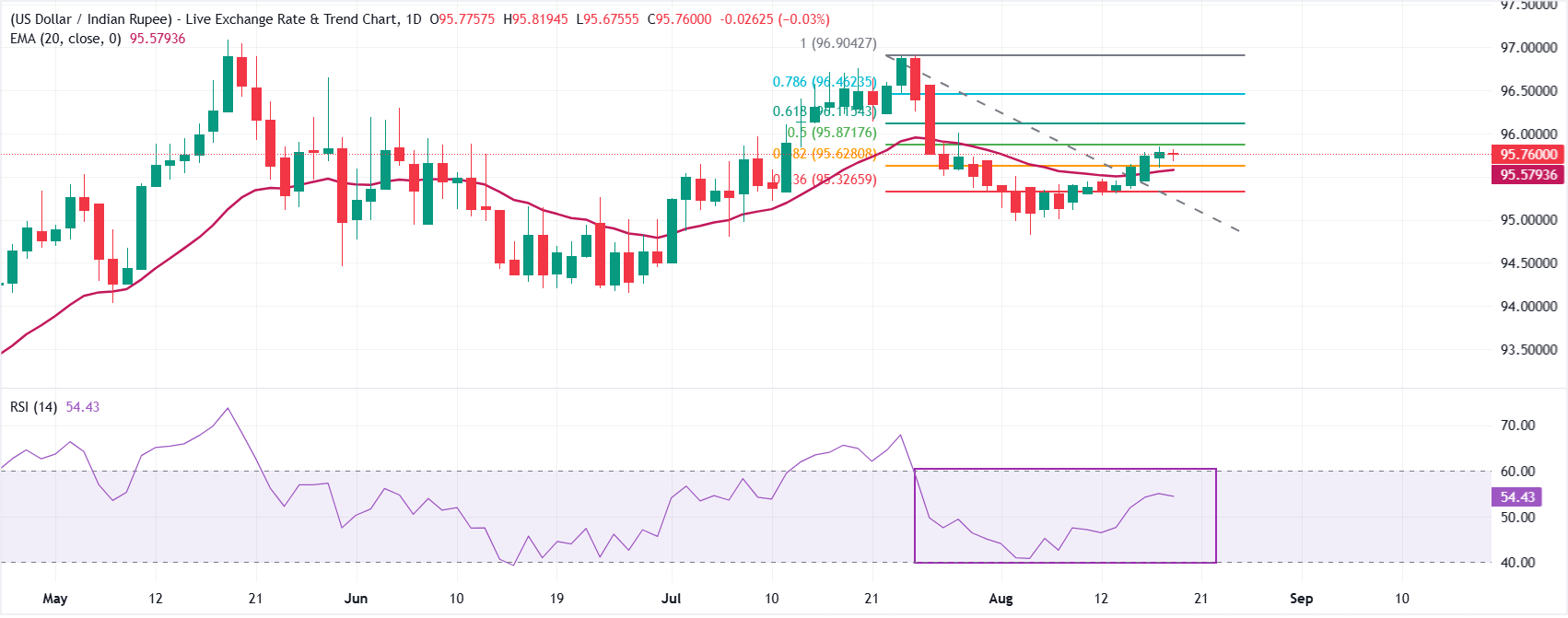
USD/INR trades at 95.76, holding a mild bullish bias as it stays above the 20-period Exponential Moving Average (EMA) near 95.58. The pair has also reclaimed the 38.2% Fibonacci retracement at 95.63, suggesting that dips are being supported, while the Relative Strength Index (RSI) around 54 points to constructive but not overextended momentum.
On the topside, immediate resistance emerges at the 50.0% Fibonacci retracement near 95.87, followed by the 61.8% level at 96.12; a daily close above this latter barrier would open the way toward 96.46 and the recent swing high around 96.90. On the downside, initial support is seen at the 38.2% retracement at 95.63, reinforced by the 20-period EMA close to 95.58, with a deeper floor at the 23.6% retracement near 95.33 if sellers regain traction.
(The technical analysis of this story was written with the help of an AI tool. Know more.)
Indian Rupee FAQs
The Indian Rupee (INR) is one of the most sensitive currencies to external factors. The price of Crude Oil (the country is highly dependent on imported Oil), the value of the US Dollar – most trade is conducted in USD – and the level of foreign investment, are all influential. Direct intervention by the Reserve Bank of India (RBI) in FX markets to keep the exchange rate stable, as well as the level of interest rates set by the RBI, are further major influencing factors on the Rupee.
The Reserve Bank of India (RBI) actively intervenes in forex markets to maintain a stable exchange rate, to help facilitate trade. In addition, the RBI tries to maintain the inflation rate at its 4% target by adjusting interest rates. Higher interest rates usually strengthen the Rupee. This is due to the role of the ‘carry trade’ in which investors borrow in countries with lower interest rates so as to place their money in countries’ offering relatively higher interest rates and profit from the difference.
Macroeconomic factors that influence the value of the Rupee include inflation, interest rates, the economic growth rate (GDP), the balance of trade, and inflows from foreign investment. A higher growth rate can lead to more overseas investment, pushing up demand for the Rupee. A less negative balance of trade will eventually lead to a stronger Rupee. Higher interest rates, especially real rates (interest rates less inflation) are also positive for the Rupee. A risk-on environment can lead to greater inflows of Foreign Direct and Indirect Investment (FDI and FII), which also benefit the Rupee.
Higher inflation, particularly, if it is comparatively higher than India’s peers, is generally negative for the currency as it reflects devaluation through oversupply. Inflation also increases the cost of exports, leading to more Rupees being sold to purchase foreign imports, which is Rupee-negative. At the same time, higher inflation usually leads to the Reserve Bank of India (RBI) raising interest rates and this can be positive for the Rupee, due to increased demand from international investors. The opposite effect is true of lower inflation.